



FEU TECH
Bachelor of Science in Mechanical Engineering
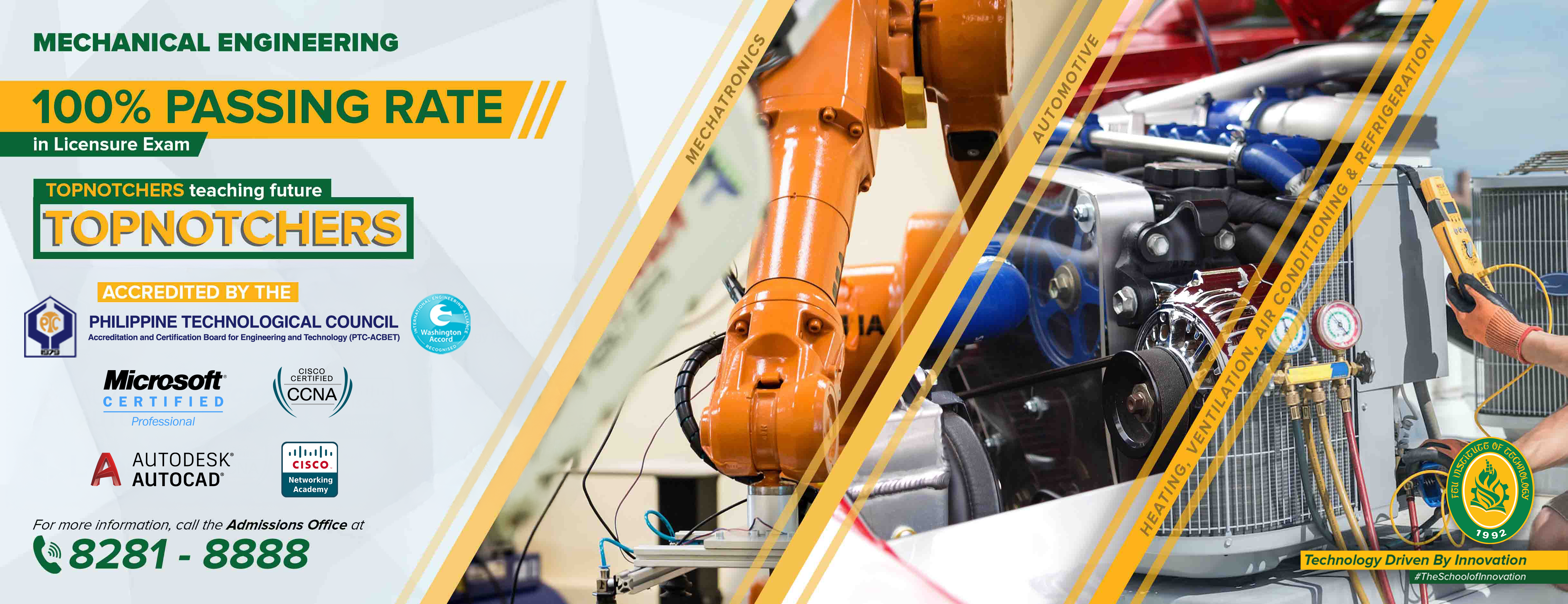
The field of mechanical engineering covers two broad areas the thermal system and the mechanical system. The traditional courses in mechanical engineering that include power plant engineering, industrial plant engineering and machine design are supplemented by new and emerging fields such as renewable energy systems, mechatronics, control system and computer applications.
The Bachelor of Science in Mechanical Engineering program has the following distinctive features: elective courses in the new and emerging technologies; industry immersion or on-the-job training; research project; and a culminating design project. The program also offers new courses such as technopreneurship, design thinking and bio-engineering.
Academic Goals
Program Educational Objectives
The graduates of the Bachelor of Science in Mechanical Engineering program are:
- Involved in solving complex problems using their technical knowledge and skills professionally and ethically, contributing to engineering practice and service activities.
- Engaged in significant roles with greater responsibilities in various sectors of the society.
- Engaged in continuing professional development activities.

Specialization / Tracking
Tracks that students may pursue include the following:
Mechatronics
The foundation of modern automation, operating at the intersection of mechanics, electronics, and computing. This multidisciplinary field equips students with the critical, high-tech skills required to design, control, and innovate within today's advanced manufacturing and robotics industries.
Materials Science and Engineering
Focuses on the combination of engineering, physics, and chemistry principles to solve real-world problems including those that are associated with nanotechnology, biotechnology, information technology, energy, manufacturing and other major engineering disciplines.

STUDENT OUTCOMES
By the time of graduation, the students should be able to:
A
Knowledge of mathematics and science to solve engineering problems.
B
Design and conduct experiments, as well as to analyze and interpret data.
C
Design a system, component, or process to meet desired needs within realistic constraints such as economic, environmental, social, political, ethical, health and safety, manufacturability, and sustainability, in accordance with standards.
D
Ability to function on multidisciplinary teams.
E
Identify, formulate, and solve engineering problems.
F
Understanding of professional and ethical responsibility.
G
Ability to communicate effectively.
H
Broad education necessary to understand the impact of engineering solutions in a global, economic, environmental, and societal context.
I
Recognition of the need for and an ability to engage in life-long learning.
J
Knowledge of contemporary issues.
K
Ability to use techniques, skills, and modern engineering tools necessary for engineering practice.
L
Knowledge and understanding of engineering and management principles as a member and leader in a team, to manage projects and in multidisciplinary environments.
Career Opportunities
Graduates of B.S.M.E. program may opt to work as:
- Automotive engineer
- Maintenance engineer
- Facilities engineer
- Instrumentation and controls engineer
- Mechanical designer
- Industrial product designer
- Plant safety engineer
- Power plant engineer
- HVAC & R engineer
- R&D Engineer
- College instructor