



FEU TECH
Bachelor of Science in Electrical Engineering
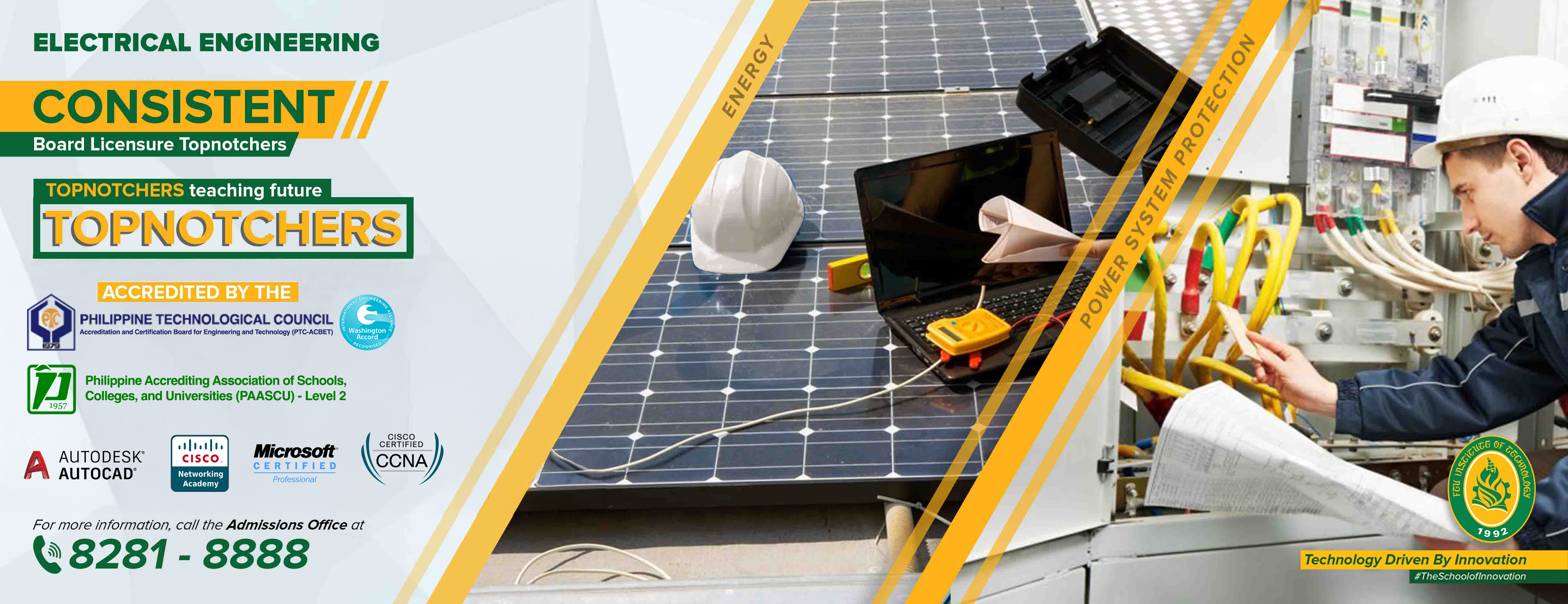
field of Electrical Engineering deals with the generation, transmission, distribution and utilization of electricity. It covers topics such as industrial and power electronics, electrical and instrumentation design and construction, machine control and automation, operations and maintenance of facilities, power systems operation, economics and protection, industrial and power plant engineering.
Electrical Engineering students of FEU Alabang are expected to learn and to experience cutting-edge design software in electrical and power systems design. They will also experience hands-on building design, wiring and installation, motor control design and wiring. With knowledge of electronics, they are expected to excel in the fields of instrumentation, automation and controls design.
Reinforced with subjects on engineering and project management, safety engineering, professional ethics and entrepreneurship, the students are trained to be the best and highly sought professionals in the industry.
Academic Goals
The graduates of the Bachelor of Science in Electrical Engineering program are:
- Involved in solving complex technical problems using the technical knowledge and skills professionally and ethically, contributing to engineering practice and service activities.
- Engaged in continuous personal and professional development activities.
- Engaged in significant roles with greater responsibilities in various sectors of the society.

Student Outcomes
A
Knowledge of mathematics and science to solve engineering problems
B
Design and conduct experiments, as well as to analyze and interpret data
C
Design a system, component, or process to meet desired needs within realistic constraints such as economic, environmental, social, political, ethical, health and safety, manufacturability, and sustainability, in accordance with standards.
D
Ability to function on multidisciplinary teams
E
Identify, formulate, and solve engineering problems.
F
Understanding of professional and ethical responsibility.
G
Ability to communicate effectively.
H
Broad education necessary to understand the impact of engineering solutions in a global, economic, environmental, and societal context.
I
Recognition of the need for and an ability to engage in life-long learning.
J
Knowledge of contemporary issues.
K
Use techniques, skills, and modern engineering tools necessary for engineering practice.
L
Knowledge and understanding of engineering and management principles as a member and a leader in a team, to manage projects and in multidisciplinary environments.
M
Assess and evaluate power systems operations under normal and abnormal conditions.
N
Analyze the operating principles related to power generation from non-conventional sources of energy.
Technical and Soft Skills
Career Opportunities
Graduates will be able to function as a competent:
- Power Engineer Power System Operation , Power System Protection, Power System Economics, Power Plant
- Design Engineer Advance Power System, Advance Electrical Designer, Machine Automation and Process Control Designer
- Illumination Engineer
- Entrepreneur
- Sales Engineer
- Distribution Engineer
- Engineering Educators and Researcher
- Instrumentation and Control Engineer
- Safety Engineer
- Maintenance Engineer
- Construction and Project Engineer
- Software Developer
- Electrical Design Inspector